
For shooters who reload their own ammunition, case quality isn’t just a preference—it’s the foundation of every round they build. And when it comes to 9mm pistol cases, not all options are created equal. Shell Shock Technologies has engineered a solution that challenges every assumption about what a pistol case can be, starting with the materials themselves and extending all the way to how those materials behave under the demands of repeated firing and reloading.
This piece takes a deeper look at the material science, structural design, and real-world performance characteristics that define the Shell Tech™ NAS³™ 9mm case—and why handloaders are increasingly choosing it over traditional brass.
Brass has been the default material for pistol case manufacturing for generations, and for good reason: it works. But “works” and “optimal” are not the same thing. Shell Shock Technologies set out to answer a harder question: what would a pistol case look like if it were engineered from scratch for performance, longevity, and reloadability?
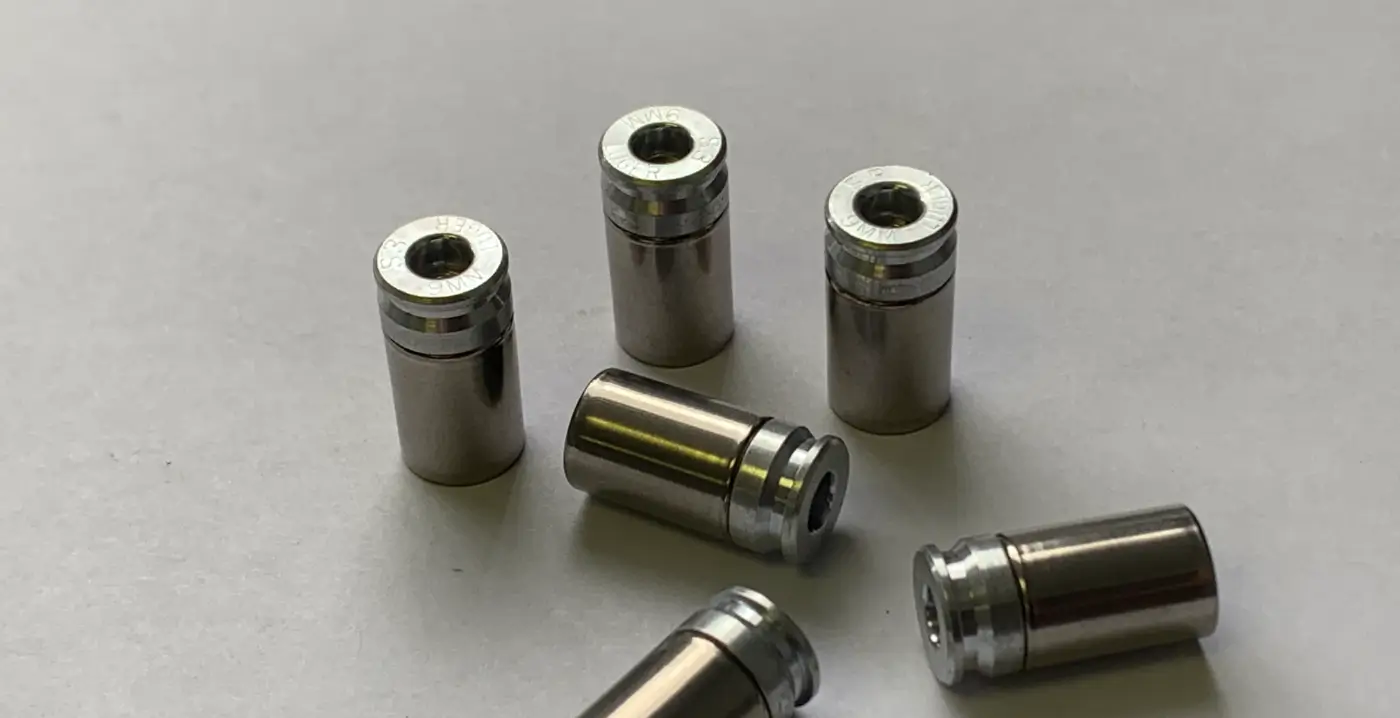
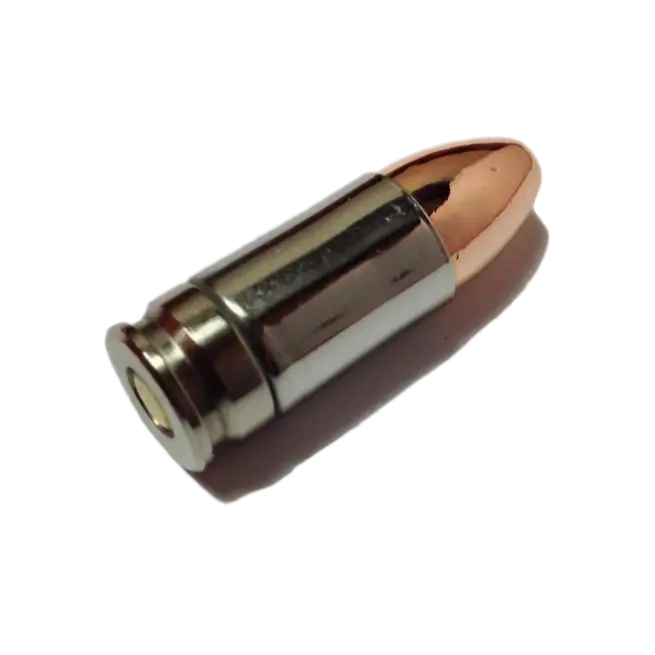
The answer is a two-piece design built from two distinct, purpose-selected materials.
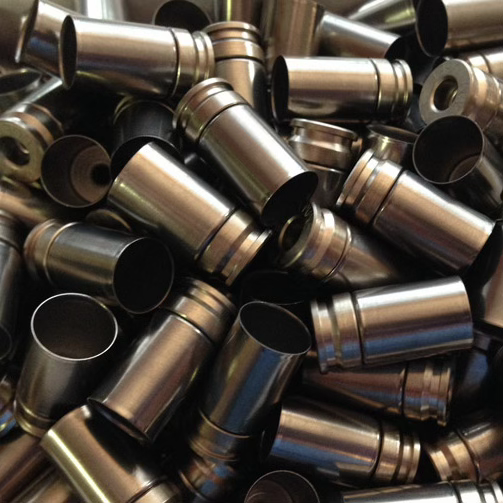
The upper portion of every Shell Tech 9mm NAS³ case is a high-tensile nickel alloy stainless cylinder. This is not conventional steel, a critical distinction. Unlike standard steel cases, which are known to be abrasive to firearm components and difficult to extract, Shell Tech’s nickel alloy stainless cylinder is functionally less abrasive than brass and is self-lubricating, requiring no external lubrication to cycle smoothly through a firearm’s action.
The material’s superior tensile strength means it can withstand the pressures of ignition without permanently deforming. More importantly for reloaders, its greater elasticity allows the case to spring back very close to its original shape after firing, a property that directly translates to more reload cycles before a case is retired.
Corrosion resistance is another area where the nickel alloy stainless cylinder outperforms brass. Humidity, storage conditions, and range environments that would pit or oxidize brass cases leave NAS³ cases unaffected.
The base of the Shell Tech NAS³ 9mm case uses a tri-valent chrome-coated aluminum construction. This component is engineered specifically to reduce wear on the ejector pin, which is a common point of accelerated wear in high-volume shooting scenarios. The aluminum base also opens the door to color anodization, allowing ammunition manufacturers and military/law enforcement agencies to use visual coding for load identification, a practical benefit that brass simply cannot offer.
Durability in a cartridge case is not a single property; it is the combination of how a case handles pressure, how it interacts with the firearm’s mechanical components, and how its structural integrity holds up over time and repeated use.
The Shell Tech 9mm NAS³ case carries a maximum tested pressure rating of 52,500 PSI, confirming that it is engineered to perform reliably at and within standard SAAMI pressure specifications for the caliber. Because of the increased internal volume of the NAS³ design, a result of the case’s improved geometry, powder combustion becomes more efficient. This allows handloaders to achieve higher velocities at standard SAAMI pressures compared to traditional brass cases. It is important to note that Shell Shock Technologies does not recommend loading beyond SAAMI specifications; the NAS³ design’s advantage lies in maximizing performance within those established limits, not exceeding them.
One of the more consequential failure modes in pistol cases is ballooning, the radial expansion of a case body beyond normal dimensions when fired in an unsupported chamber. This is particularly problematic in semi-automatic pistols, where the feed ramp creates a partially unsupported chamber. Shell Tech’s NAS³ 9mm case is engineered specifically to not balloon when fired in an unsupported chamber, dramatically reducing the tendency to jam and improving overall reliability across a wide variety of 9mm-chambered firearms.
A durable case that damages the firearm defeats its own purpose. Shell Tech’s nickel alloy stainless cylinder is functionally less abrasive than brass, meaning repeated cycling through the action does not accelerate wear on the breech, extractor, or ejector mechanisms in the way that some inferior case materials do. Combined with the aluminum base’s reduced ejector pin wear, the NAS³ design is engineered to preserve the firearms it feeds, an important consideration for anyone shooting high volumes.
For the handloading community, a case’s reload life is arguably its most important long-term characteristic. Every additional reload cycle represents both cost savings and the confidence that the case will perform consistently each time. Shell Tech NAS³ 9mm cases are designed to be reloaded significantly more times than traditional brass cases.
Brass hardens over time. Each firing cycle stresses the material, and brass gradually loses its ability to return to spec dimensions, leading to cracked case mouths, split necks, and eventually, case failure. The nickel alloy stainless cylinder used in Shell Tech’s NAS³ cases has greater elasticity than brass and springs back very close to its original shape after each firing. This reduces the cumulative material fatigue that shortens brass case life and allows NAS³ cases to sustain more reload cycles before reaching the end of life.
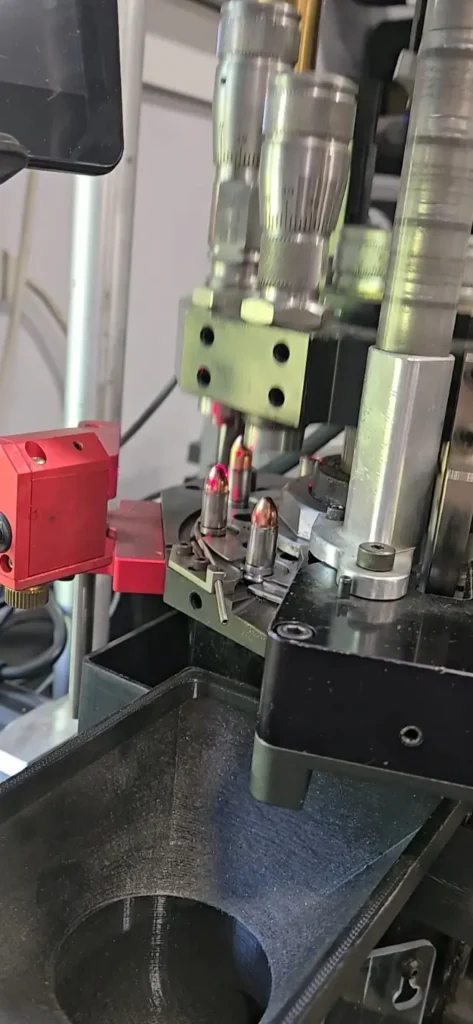
A major concern for reloaders considering a new case platform is equipment compatibility. Shell Tech NAS³ 9mm cases are designed to work on conventional loading equipment, including high-speed plate loaders, with no required changes to primers, powder, or projectiles. Any 9mm caliber bullet is compatible, and the cases are recommended for use in any firearm chambered for 9mm ammunition. Handloaders do not need to invest in new dies or presses to begin loading NAS³ cases; the transition is designed to be as straightforward as possible.
Precision handloaders understand that case consistency is the foundation of consistent velocity. Shell Tech’s NAS³ manufacturing process produces cases with uniform wall thickness and controlled dimensions, contributing to more consistent round-to-round performance, a quality validated by independent testing that has recorded a standard deviation of 0.93 fps in velocity across rounds. For competitive shooters and precision-minded reloaders alike, that level of consistency is a tangible, measurable advantage.
Shell Tech NAS³ 9mm cases cool significantly faster after ejection than brass cases, a property that benefits shooters retrieving brass from the range. That said, as with all fired ammunition, the case remains hot immediately after discharge and should always be handled accordingly. Faster cooling is a real advantage; it simply is not instantaneous.
The performance advantages of the NAS³ design are paired with practical benefits that matter at scale. NAS³ cases are approximately 40–50% lighter than equivalent brass cases—the Shell Tech 9mm Luger case weighs approximately 1.93 grams—making a meaningful difference for military and law enforcement personnel carrying loaded ammunition in bulk. For civilian shooters, the weight reduction translates to lighter range bags and more rounds per carry.
The use of a stainless-steel cylinder and aluminum base also eliminates dependence on “red metal,” the term commonly used for copper and brass alloys, whose commodity prices introduce cost volatility into traditional ammunition manufacturing. NAS³ cases use lower-cost raw materials with more stable pricing, contributing to a cost-competitive case platform over the long term.
The nickel alloy cylinder is also magnetic, which simplifies cleanup at both indoor and outdoor ranges by allowing spent cases to be collected with a magnet, a small but genuinely useful operational advantage.
The Shell Tech 9mm NAS³ case is rated for a recommended ambient temperature range of -25°F to +145°F, making it suitable for use in extreme environments, from cold-weather training and operations to hot desert conditions. This thermal resilience reflects the inherent stability of the case materials and their resistance to dimensional changes under temperature stress.
The case is the most reused component in any handloading operation. Choosing a case that holds its dimensions longer, resists corrosion, cycles more smoothly, and recovers its shape more completely after each firing is not a minor upgrade; it is a fundamental improvement to the reloading process. Shell Shock Technologies’ 9mm NAS³ case brings together material science, precision manufacturing, and an understanding of how cases actually perform under real-world conditions to deliver a platform that outperforms traditional brass at every stage of its service life.
For shooters ready to explore what reloading looks like with a next-generation case, Shell Tech’s unprimed 9mm NAS³ cases are available now at shellshocktechnologies.com. The future of pistol case technology is already here.